

A seller we sat with in Surat was doing 14 orders a day on AJIO, steady, profitable, boring in the best way. Then she added Meesho the obvious way: second browser tab, second Excel sheet, second morning ritual. Within three weeks her AJIO dispatch slipped twice, her first Meesho settlement sat unreconciled, and her honest summary was: “I added thirty percent more revenue and a hundred percent more work.” That trade is the default outcome of multi marketplace selling in India, and it is entirely avoidable.
This playbook is the version that avoids it. It covers when to expand (and the cases where you should not), what actually doubles when you add a channel and what does not, how to map a catalog without rewriting your business, and how to keep one money view when two marketplaces pay you on two different clocks.
When to expand, the five-gate readiness test
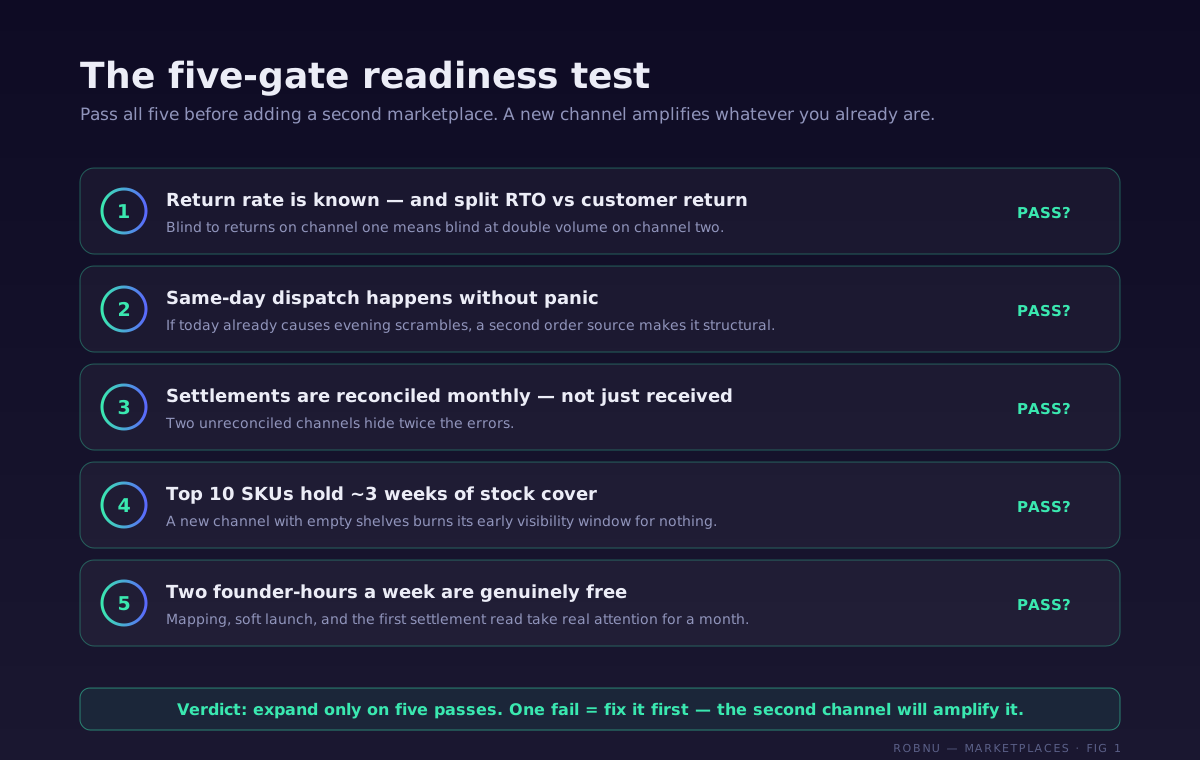
A second marketplace is an amplifier. If your first channel is healthy, it amplifies revenue. If your first channel has an unmeasured returns problem or a settlement pile you never reconcile, it amplifies that instead, at double the volume. So the readiness test is not about ambition; it is about whether channel one is under control:
- You know your return rate, and you can split it into RTO versus customer returns. If you cannot, you will not be able to tell whether the new channel's returns are normal or a fire.
- Same-day dispatch happens without panic. If today's volume already causes evening scrambles, a second order source makes the scramble structural.
- You reconcile settlements monthly, line by line, not just receive them. Two unreconciled channels hide twice the errors.
- Your top 10 SKUs hold about three weeks of stock cover. A new channel with empty shelves burns its early visibility window for nothing.
- You have two founder-hours a week free. Mapping, soft-launching, and reading the first settlement takes real attention for a month.
One honest counter-case: if your single channel is structurally capped, your category is saturated, your listings are mature, growth has flattened for two quarters, expansion can be the right move even before everything above is perfect. But fix the measurement gates first. You can expand with imperfect stock cover; you cannot expand safely while blind to your own return rate.
What doubles and what does not
The fear behind “I cannot handle a second marketplace” is usually undifferentiated. Break the work into one-time and recurring, and the picture changes.
One-time work: account registration and GST verification, catalog mapping, price setting, packaging tweaks. This is a real cost, call it two to three weeks of part-time effort for a 20-SKU soft launch, but you pay it once.
Recurring work is where businesses break. Accepting orders on two panels. Generating labels, slips, and invoices in two formats. Closing two manifests against two courier pickups. Chasing two returns flows with two different windows. Reconciling two settlement formats on two payment cycles. Done panel by panel, each of these roughly doubles, and worse, they interleave, so you context-switch all day. That is what turned our Surat seller's 30% revenue bump into a 100% workload bump.
The way out is to stop treating the panels as the workplace. The panels become connection points; the work happens in one system. One order queue regardless of source. One document run that knows AJIO needs its format and Meesho needs its own. One packing line sorted by courier pickup, not by marketplace. One reconciliation view that matches every settlement line to an order, whichever channel it came from.

Catalog mapping without losing your mind
Do not port your whole catalog. Take your top 20 SKUs by settled profit, not by order count, and map only those. For each one, three decisions:
- Audience fit. A ₹1,499 brand-positioned kurta set that works on AJIO may need a different hero image and a sharper price story for Meesho's value-led buyer, or it may not belong there at all. Expect 3 to 5 of your top 20 to stay home.
- Content rewrite, not copy-paste. Each marketplace has its own image rules, title patterns, and size-chart conventions. Reused content that ignores them is the fastest route to a returns problem on the new channel. Honest, channel-correct listings are return-prevention, the same logic as on your first marketplace.
- Price for the channel's economics. Commission structures, return rates, and shipping deductions differ. Run the per-order maths per channel before you publish, with illustrative numbers from each portal's fee pages, not your AJIO assumptions wearing a Meesho costume.
On stock: keep one shelf truth. The classic two-channel failure is overselling, both panels believe they own the full shelf, a sale-day spike hits both, and you cancel orders on one channel to protect the other. Cancellations hurt your seller metrics on every marketplace, so set a buffer rule from day one: the new channel sees total stock minus open first-channel orders minus one safety unit on fast movers.
One money view across channels
Two marketplaces means two settlement calendars, two statement formats, two sets of deduction codes, and two different definitions of when a sale becomes money. Meesho works on a delivery-anchored payout cycle; AJIO's settlement statements carry their own commission, penalty, and tax line structure. If you read each in its own portal, you will never see the one number that matters: what the whole business actually earned this month after every deduction on every channel.
The fix is a three-way match done centrally, order value versus marketplace statement versus bank credit, for every channel in one place. That is the discipline; an agentic OMS just removes the labour of it. Either way, never let the second channel's first settlement go unread. The first statement is where you learn the new channel's real deduction behaviour, and reading it line by line in week four costs you thirty minutes. Discovering a systematic error in month four costs you the whole quarter's leak.
Two more line items deserve their own row in the cross-channel money view. First, the tax lines: GST TCS and income-tax TDS are deducted inside each marketplace's settlements separately, and both feed reclaim workflows on the government portals, if you only track them for one channel, you are leaving the other channel's credits unclaimed. Second, per-channel return costs: a channel can look profitable on settled revenue and turn marginal once its reverse-logistics fees are allocated back to it. The question the money view must answer is not “which channel sells more?” but “which channel keeps more per order after everything?”, and the answer changes pricing, stock allocation, and where your next hundred catalog hours go.
The mistakes that undo second channels
Four failure patterns come up again and again when we talk to sellers whose expansion went sideways. None of them is exotic; all of them are avoidable on day one.
Launching into a sale event. The new channel's first week already carries unknowns, new document formats, a new courier handover rhythm, a returns culture you have not felt yet. Stacking a festival spike on top means you debug your second channel at triple volume. Launch in a quiet fortnight; the sale will come around again soon enough.
Treating channel two as a clearance outlet. Dumping dead stock on the new marketplace feels efficient, but the new channel's early reviews and seller metrics are its compounding asset. Ten orders a day of your proven movers builds a base; fifty orders of stock nobody wanted builds a one-star wall you then sell against for a year.
Splitting the team by marketplace. “You handle Meesho, I keep AJIO” sounds tidy and quietly doubles every process, two people now independently learn documents, returns, and settlements instead of one operation absorbing both. Split by function (one person owns packing, one owns exceptions and money), never by channel.
Identical pricing everywhere. Same number on both channels ignores that commissions, return rates, and shipping deductions differ, the identical sticker produces different settled margins, sometimes on opposite sides of zero. Price each channel from its own cost stack, and re-check after your first month of real settlement data rather than trusting the fee tables alone.
The 30-day expansion timeline
Compressed, the playbook runs in a month. Week one: map the top 20 SKUs, rewrite content, set channel-correct prices. Week two: soft-launch 10 SKUs, route both channels through one order queue, ship from the same shelf and the same packing line. Week three: the first returns wave arrives, tag every return as RTO or customer return, per channel, from day one. Week four: the first settlement lands; reconcile it line by line, then make the call, scale up, hold, or fix something before adding more SKUs.
Hold the soft-launch discipline even if early numbers look great. Ten SKUs for thirty days is enough to learn the channel's document quirks, returns culture, and settlement format at a volume where mistakes are cheap. The seller who maps two hundred SKUs in week one learns the same lessons at twenty times the cost.

Where Robnu fits
Robnu runs AJIO and Meesho today, both integrations live, both channels landing in one order queue, with documents, returns tracking, and per-order profit handled per channel and rolled up into one money view. (Robnu is independent software built for marketplace sellers; it is not affiliated with or endorsed by AJIO or Meesho.) Amazon, Flipkart, and Myntra are on the roadmap, so the playbook above is also your setup for channel three, the marginal cost of each addition keeps falling when the operation is unified.
And the economics of trying it are simple: Robnu is free for everyone right now, every feature, every order, no card, no trial timer. If you stay under 25 orders a day across channels, it stays free forever even after paid pricing launches. Your second marketplace should cost you a catalog mapping exercise, not a second job. Set it up so it does.