

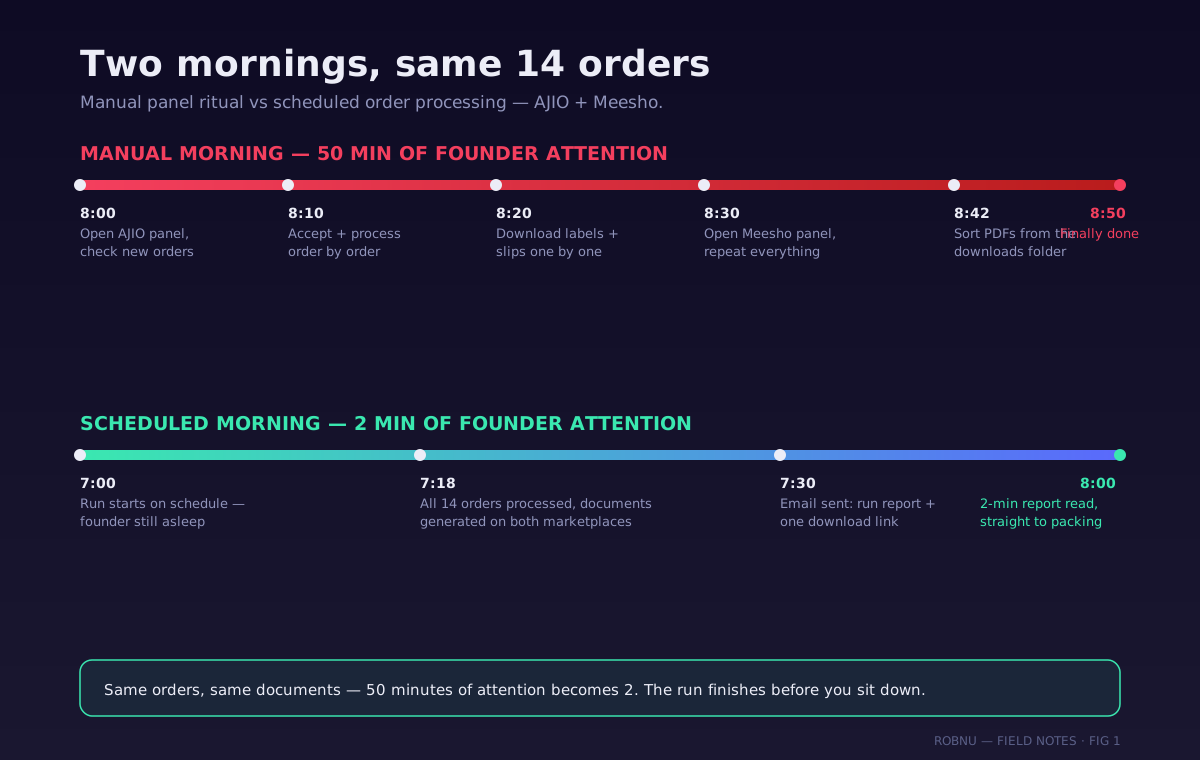
8:00 AM. Open the AJIO panel. Check new orders. Accept. Process. Download label, download slip, repeat fourteen times. 8:30: open the Meesho panel and do it all again. 8:42: dig through the downloads folder matching PDFs to orders. 8:50: done, and the best hour of your day is gone. If that paragraph reads like your calendar, this post is about deleting it. Scheduled order processing exists so the ritual runs without you.
We are going to anatomize the manual morning honestly, what it costs in hours and in errors, and then walk through the model that replaces it: schedule, run, and an email with a download link. By the end you should be able to judge whether your morning is a routine worth keeping or a tax worth deleting.
The morning ritual, anatomized
The ritual feels productive because it is busy. But break it into steps and almost none of them involve a decision. Checking for new orders is a page refresh. Accepting an order is a click. Processing it is three clicks in a fixed sequence. Downloading a label is a click plus a wait. The only genuine decisions in a typical morning are the odd address that looks wrong and the odd stock count that does not match, maybe two judgment calls out of a hundred clicks.
Two marketplaces double the ritual without doubling the orders. AJIO and Meesho have different panels, different processing sequences, different document formats. Sellers we have sat with at 10 to 15 orders/day across both report 40 to 60 minutes of panel work every single morning, and the second panel is where mistakes live, because attention is already spent by the time you open it.
Put real order numbers on it and the ritual gets less romantic. AJ-55310, a ₹749 dress: accept, process, label, slip, four interactions. MS-44102, a ₹312 kurta set: same again in a different interface, plus a pause because the buyer's pin code looks odd. Across fourteen orders that is roughly a hundred interactions, of which two required a human brain, the odd pin code and a stock count you wanted to double-check. The other ninety-eight were performed by a founder doing data entry at the most expensive hourly rate in the company.
What the ritual actually costs
Forty-five minutes a day is roughly 23 hours a month, half a working week spent performing clicks a machine performs identically. But the hours are the smaller cost. The bigger one is the error tail, because every error in this list converts directly to rupees:
- The missed order on panel two. Attention fades by the second marketplace. An order sits unprocessed past its dispatch SLA, and the penalty or the cancellation lands two settlement cycles later.
- The late manifest. A morning that starts 30 minutes late, a sick day, a school run, a power cut, cascades into a manifest that closes after the cutoff. The timestamp is the timestamp; there is no dispute.
- Document drift. Labels re-downloaded, slips mismatched to boxes, yesterday's PDF stuck to today's order. Each one is a wrong-item return or a courier rejection waiting to happen.
- The growth ceiling. A ritual that takes 50 minutes at 14 orders takes 2 hours at 40. Manual processing quietly caps how big you are allowed to get.

How scheduled order processing works
The model has three parts, and all three matter.
Schedule. You pick a time, say 7:00 AM, comfortably before courier cutoffs, and the run executes every day at that time whether you are at the desk, on a train, or asleep. Sale season tip: add a second afternoon run so late orders still make same-day dispatch.
Run. The agent does what you used to do, in the same sequence, on both marketplaces: fetch new orders, accept, process, generate labels and packing slips, prepare manifests. The difference from simple automation rules is what happens when a step fails. A rule stops or skips silently; an agentic run retries, works around what it can, and explicitly flags what it cannot, which is why we call Robnu an agentic OMS rather than a scheduler with macros.
Report. When the run finishes you get an email: how many orders processed, what was generated, what needs your attention, and one download link containing every document from the run, named by order. No panel login, no downloads folder archaeology. The report is designed to be read on a phone in two minutes.
A reasonable worry at this point: do I trust it? The honest answer is that trust is earned the same way you would earn it from a new employee, by checking their work until you stop needing to. For the first week, run the schedule and then open the panels anyway; compare what the report claims against what the marketplace shows. Sellers who do this consistently report the same arc: day one is anxious double-checking, day four is spot-checking, and by week two the panels are only opened when the report says something needs attention. The difference from a new employee is that the run does not have an off day, does not improvise, and writes down everything it did.
Choosing the schedule: work backwards from the cutoffs
The schedule is the one design decision you make, so make it deliberately. Start from the hard constraint and work backwards: when does your courier pickup actually happen, and when do your manifests need to close? If the pickup boy arrives between 3 and 4 PM, your parcels need to be packed by 2:30, which means your packing block needs documents in hand by 11, which means the run should complete by 8, so schedule it for 7:00 with comfortable headroom. The point of the buffer is not pessimism; it is that the run's occasional slow morning (a marketplace panel responding sluggishly, a retry on a flaky order) should eat the buffer, never the cutoff.
Two more scheduling decisions worth stealing from sellers who have tuned this: first, run every day, including Sundays and holidays, orders do not respect your calendar, and the cost of a run that finds nothing is zero. Second, if your marketplaces allow same-day dispatch on afternoon orders, add a second run around 1 PM so the morning's late arrivals make the same pickup. The schedule should mirror your courier reality, not a generic template.
Sale days: the schedule that flexes
Scheduled order processing earns its keep most visibly on the days the ritual would have broken you. During a sale event, orders do not arrive in a tidy overnight batch, they stream in all day. The manual ritual answer is to live inside both panels for twelve hours. The scheduled answer is to add runs: morning, midday, late afternoon, each one sweeping up everything since the last, each one producing the same report and the same single download. And when something odd lands between runs, a one-click manual run covers the gap without dismantling the system. Volume changes the number of runs; it does not change your job description.

What your morning looks like after
The honest version, because nothing reaches zero: you still read the report. You still handle the flagged exception, in our experience one order in thirty or forty earns a flag, usually an address oddity or a stock mismatch. You still pack, and you should; at this scale your hands on the parcel are a quality advantage. What disappears is the clicking. The 50-minute ritual becomes a 2-minute read plus the occasional one-click decision, and your first real hour goes to pricing, catalog, or the settlement review you have been postponing for three weeks.
There is also a quieter benefit that takes a few weeks to notice: the run is the same every day, so deviations become visible. When processing was manual, a morning that took 70 minutes instead of 45 just felt like a bad morning. When the run report says 14 orders on a day that is usually 9, or flags three address anomalies in a week that usually has none, you are looking at a signal, a listing suddenly getting traction, or a pin-code pattern worth checking before it becomes an RTO cluster. Consistency is what makes anomalies legible. A ritual performed by a tired human hides them.
Where to start with scheduled order processing
Run tomorrow morning manually one last time, and time yourself honestly, panel to panel, first click to sorted documents. That number times 30 is your monthly ritual tax. Then connect your stores, set a 7:00 AM schedule on Robnu's agentic order processing, and compare the two mornings side by side for a week.
Robnu is free for everyone right now, every feature, every order, no card, no trial timer. If you stay under 25 orders/day, it stays free forever even after paid pricing launches. The ritual, on the other hand, charges you every single morning.